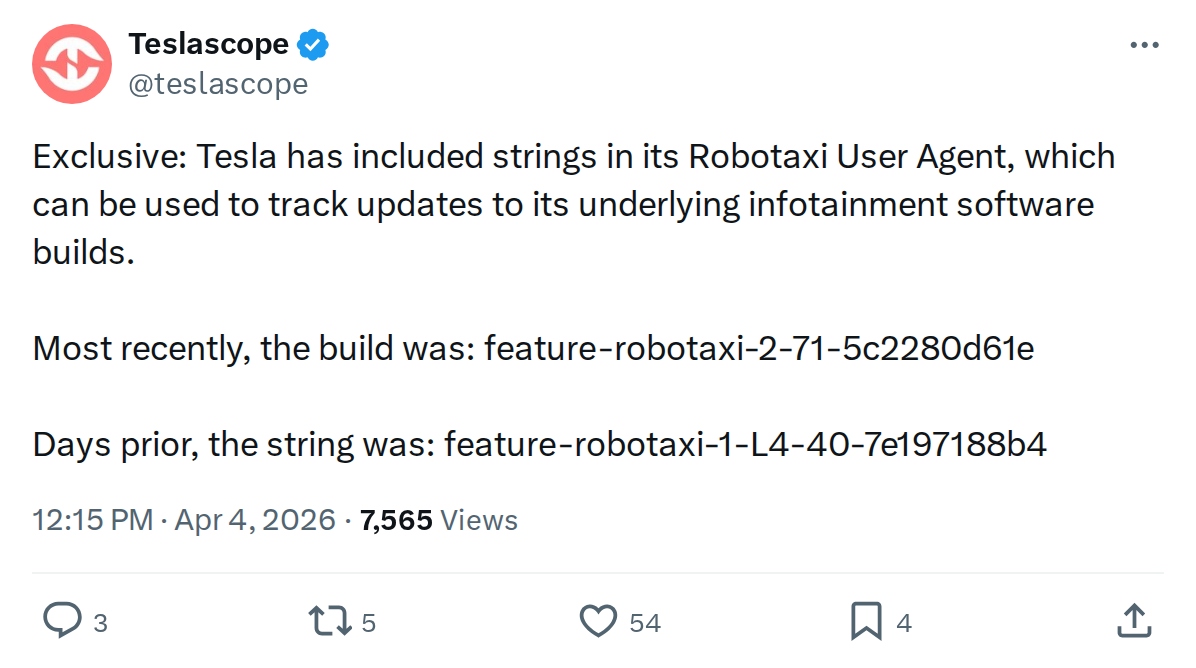
The News: Teslascope has discovered internal build strings inside Tesla's Robotaxi User Agent, revealing a clear jump in infotainment software versions — from feature-robotaxi-1-L4-40 to feature-robotaxi-2-71 within days.
Why It Matters: This is the first publicly trackable window into Tesla's Robotaxi software iteration cycle, confirming that autonomous ride-hailing development is moving at a rapid pace ahead of planned US city expansions.
Source: @teslascope on X
Tesla's Robotaxi Software Is Iterating Fast — And Now We Can Track It
For the first time, Tesla watchers have a concrete, repeatable method to monitor how quickly the company is evolving its Robotaxi software stack. Teslascope, the Tesla data intelligence platform, has identified internal build strings embedded inside Tesla's Robotaxi User Agent — and what those strings show is a software team that isn't standing still.

📊 Key Figures
| Metric | Value | Context |
|---|---|---|
| Previous Build | feature-robotaxi-1-L4-40-7e197188b4 | Observed days before current |
| Current Build | feature-robotaxi-2-71-5c2280d61e | Most recent observation |
| Branch Jump | Branch 1 → Branch 2 | Suggests a major feature branch promotion |
| Austin Geofence | ~245 sq miles | Current unsupervised operating area |
| Expansion Cities (H1 2026) | 7 new metros | Dallas, Houston, Phoenix, Miami, Orlando, Tampa, Las Vegas |
What the Build Strings Actually Tell Us
Software build strings aren't glamorous, but they're one of the most honest signals in engineering. The structure Tesla is using — feature-[product]-[branch]-[build number]-[commit hash] — follows standard CI/CD pipeline conventions. Breaking down what changed:
- Branch jump (1 → 2): This isn't a minor patch. Moving from branch 1 to branch 2 in a named feature branch typically signals that a significant body of work has been completed, reviewed, and promoted — or that the team has opened a new parallel development track.
- Build number jump (40 → 71): Within just a few days, the build number advanced by 31 increments. That's a high-velocity iteration rate, suggesting automated builds triggered by frequent code commits.
-
The L4 label disappearing: The previous build explicitly contained
L4in its string — a direct reference to SAE Level 4 autonomy (no human intervention required within a defined operational domain). The new string drops this label. Whether that reflects a branch naming convention change or something more substantive about the software's autonomy classification is unclear, but it's worth watching.

Where the Robotaxi Program Stands Right Now
These build strings don't exist in a vacuum. Context matters. Tesla's Robotaxi program is currently operating in Austin, Texas with a small fleet of unsupervised vehicles — fewer than a dozen running at any given time across an approximately 245-square-mile geofence. The broader Austin fleet of roughly 37–42 vehicles still includes safety monitors for the majority of rides.
In the Bay Area, a safety driver is still required. But Tesla has confirmed rapid expansion: seven new major US metropolitan areas — Dallas, Houston, Phoenix, Miami, Orlando, Tampa, and Las Vegas — are slated to come online within the first half of 2026. Pilot programs are reportedly already underway in 15–20 US cities.
That expansion timeline creates real pressure on the software team. The build velocity Teslascope is now able to track suggests the engineering side is keeping pace.
🔭 The BASENOR Take
Timeline: Build string jump observed within days of each other — April 2026
Impact Level: 🟡 Medium — No direct owner action required, but a meaningful signal for anyone tracking Robotaxi's readiness curve
Confidence: 🟢 High — Build strings are directly observable data, not speculation
What Teslascope has effectively done here is hand the Tesla community a new instrument for tracking Robotaxi progress. Up until now, software development progress was largely inferred from Elon tweets, FSD release notes, or city-by-city operational announcements. Build strings give a more granular, near-real-time view.
The branch jump from 1 to 2 is the detail we'd watch most closely. In software development, promoting a feature branch typically means a milestone has been hit — whether that's a capability threshold, a safety validation gate, or a regulatory submission checkpoint. The disappearance of the explicit L4 label in the new branch name is an open question that warrants follow-up as more builds are observed.
For Tesla owners curious about when Robotaxi might reach their city, this kind of build tracking is the closest thing to a real-time development dashboard the public has ever had access to. Follow our FSD and self-driving coverage as Teslascope continues to monitor these strings.
📰 Deep Dive
The significance of Teslascope's discovery goes beyond the specific build numbers. Tesla has historically kept its internal software development opaque — release notes are curated, timelines are vague, and the gap between what's being developed and what's publicly acknowledged can be wide. Embedded User Agent strings represent an unintentional transparency window: they exist for functional reasons (server-side routing, compatibility checks, logging), not for public consumption.
The fact that the Robotaxi software has its own distinct User Agent — separate from standard Tesla vehicle software — reinforces that this is a purpose-built stack, not simply a variant of the consumer FSD software. That architectural separation has implications for how quickly Tesla can iterate on the ride-hailing experience without being constrained by the broader OTA update cycle that governs owner vehicles.
With seven cities confirmed for H1 2026 expansion and pilot programs reportedly active in up to 20 metros, the pressure on this software team is real and near-term. A build cadence that produces 31+ increments in a matter of days suggests the team is in an active integration and testing phase — exactly what you'd expect ahead of a major geographic rollout. Whether the software is ready to support unsupervised operation in those new cities on launch day, or whether safety monitors will again be required initially, remains the central question. The build strings won't answer that directly — but they'll tell us if the pace of development is accelerating or stalling.
🚕 Following the Robotaxi rollout? See every operating city, launch date and announced market in our Tesla Robotaxi Tracker.
Related Gear
Gear up your Tesla with tested, custom-fit BASENOR accessories — shop Tesla accessories →
Sources & reporting notes
The links below identify the material source records used for this report.
- @teslascope on X (2026-04-04T04:15:28.000Z) — Direct source
- @wholemars on X (2026-04-04T04:30:24.000Z) — Direct source
Source links are preserved as published or accessed. See our editorial standards and corrections policy.
The BASENOR Editorial Desk covers Tesla, SpaceX, and related technology, curating reporting from primary sources — official accounts, regulatory filings, and software release data. Every article passes source-record and fact-checking review before publication. About the newsroom.
This report was curated by the BASENOR Editorial Desk from the sources listed above. Read our editorial standards or email editorial@basenor.com to report an error.