
Tesla's Full Self-Driving software is about to take its most technically ambitious step yet — and new video evidence shows FSD V15 already has an "ASS" feature active in testing. FSD V15, confirmed for December 2026 as part of the annual Holiday Update, carries a feature set that goes well beyond incremental polish — a 10x larger AI model, a redesigned visual interface, AI-based mapping, and software that is functionally identical to what powers Tesla's commercial robotaxi fleet in Austin. For owners who have been watching FSD mature through V12, V13, and V14, this is the release that closes the gap between consumer product and autonomous service.
How We Got Here
Each major FSD generation has had a defining characteristic. V12 was the architectural shift — the move to an end-to-end neural network that replaced hundreds of hand-coded rules with a single learned model. V13 refined that foundation, measurably cutting the number of driver interventions per mile. V14 introduced point-to-point travel and represented the moment FSD became genuinely usable for everyday driving, accelerating mainstream adoption.
V15 is a different kind of leap. It is not primarily about fixing edge cases or smoothing out existing behavior. It is a ground-up scaling of the underlying AI, paired with new capabilities that address some of the most persistent complaints from daily FSD users.

What V15 Actually Brings
According to confirmed statements from Elon Musk and Tesla Head of AI Ashok Elluswamy, V15 ships with the following:
A 10-billion-parameter AI model. This is roughly a 10x increase over V14's model size. Scaling parameters at this magnitude typically translates to better generalization — the system handles unfamiliar scenarios more gracefully because it has learned from a vastly larger representation of driving situations. This is the single biggest architectural change in V15 and underpins most of the other improvements.
Pothole avoidance. Confirmed directly by Musk, this is a feature owners in older infrastructure markets have been requesting for years. The system will actively steer around road damage rather than driving through it — a practical, suspension-saving capability that also demonstrates improved real-time road surface interpretation.
AI-based mapping and navigation. V15 introduces Tesla's new AI-driven mapping architecture, initially applied at trip departures and arrivals. This replaces reliance on static map data with a dynamically interpreted understanding of the environment — a significant shift in how FSD plans and executes routes.
Redesigned UI. Musk has described the new interface as re-rendering reality in a way that will feel substantially different from the current visualization. Expect a more detailed, real-time representation of what the car sees and how it is interpreting the world around it.
HOV lane handling and merge behavior. Two of the most frequently cited FSD frustrations — unnecessary avoidance of HOV/carpool lanes and last-second lane changes ahead of merges or turns — are confirmed to be addressed in V15.
Home garage parking. Musk confirmed V15 will be able to park in a home garage, extending the hands-free envelope to one of the most spatially constrained environments a car encounters.
Safety and hazard prediction improvements. Elluswamy confirmed enhanced collision avoidance, earlier hazard detection, and faster reaction times — the kind of foundational safety work that does not generate headlines but matters most in real-world use.
"ASS" feature. Video captured in an early V15 build shows a feature labeled "ASS" present within the software. Dirty Tesla (@DirtyTesLa) shared footage of the feature on November 23, 2026. The exact functionality has not been officially detailed by Tesla, but its presence in V15 testing points to ongoing development of new autonomous capabilities within the suite.

Hardware Compatibility and Rollout
V15 is confirmed to run on Hardware 4 (HW4/AI4) vehicles, and early access may arrive ahead of the full December Holiday Update rollout for HW4 owners. The picture for Hardware 3 vehicles is less clear — official guidance on HW3 compatibility is still pending, with the possibility of a delayed or separate build for that hardware generation. Owners on HW3 should watch for official communication before the Holiday Update drops.
The wide rollout is anticipated under software version 2026.44.25 or later. As with all FSD releases, V15 remains a supervised system — an attentive driver is required at all times regardless of capability level.
The Robotaxi Connection
Perhaps the most strategically significant detail about V15 is what it shares with Tesla's commercial operations. According to available reporting from multiple sources, the software running Tesla's Cybercabs and Model Y robotaxis in Austin is functionally identical to the FSD V15 consumer release. That means every improvement Tesla makes to the consumer product directly benefits the robotaxi fleet, and vice versa — a unified development model that is unusual in the autonomous vehicle industry.
Select Model Y owners in Austin may be able to join the robotaxi network with their personal vehicles as early as December 2026, with a broader Q2 2027 target for customer-owned vehicles to participate in the fleet. V15 is the software that makes that possible.
For owners who have followed FSD through its neural network era, V15 represents the point where the consumer product and the commercial service converge. Whether the December timeline holds — and how HW3 owners are handled — will define how broadly that convergence lands. For our ongoing coverage of FSD developments, see our FSD coverage.
Update history
- November 23, 2026 — Added "ASS" feature spotted in FSD V15 testing, with video evidence shared by @DirtyTesLa on November 23, 2026.
Updates
📌 UPDATE — November 22, 2026
Early real-world testing of FSD V15 is already surfacing ahead of the official December rollout. Prominent Tesla watchers are sharing hands-on footage confirming three headline capabilities in action: pothole avoidance is performing well in live driving conditions, multi-destination navigation including parking garage maneuvers is running smoothly, and a new visualization layer now draws bounding outlines around perceived parking areas on the display — a UI touch not previously detailed. The parking visualization in particular is drawing attention as an unexpected quality-of-life addition on top of the core feature set.


📌 UPDATE — November 22, 2026
Early FSD V15 testers are already sharing real-world footage, and the results are turning heads. @DirtyTesLa posted three back-to-back clips overnight showcasing pothole avoidance in action, accurate parking in a personal designated spot, and — most strikingly — Reality View's augmented navigation overlays. On Reality View, he noted he was "actually surprised when I looked up and the arrows weren't actually floating mid air," suggesting the immersion is convincing enough to blur the line between display and reality. These are the first widely circulated owner videos confirming all three headline features are functional ahead of the full December rollout.


📌 UPDATE — November 21, 2026
Community analysis of FSD V15 suggests the update is 25x safer than V14, a figure that's generating significant buzz ahead of the December rollout. If the claim holds, @wholemars extrapolates that a known V14 record streak of 36,674 miles without intervention could theoretically scale to nearly 916,850 miles on V15 — meaning the average owner may never experience a disengagement at all. As Whole Mars Catalog notes, this kind of safety margin is precisely what separates supervised FSD from a fully unsupervised product: individual drives feel identical, but the statistical floor has shifted dramatically. These figures are community-sourced and unverified by Tesla, so treat them as directional rather than official — but the trajectory aligns with Tesla's stated goal of launching unsupervised robotaxi service.
"You won't notice 25x safety on your initial drive, because you're used to 0 intervention drives already. But that improvement is what lets you go from supervised to unsupervised." — @wholemars
📌 UPDATE — November 21, 2026
Tesla has begun rolling out FSD (Supervised) v15.0.1 to the first batch of owners via software update 2026.38.6.11 — ahead of a broader December release. The confirmed changelog highlights an upgraded vision encoder now shared across FSD, Robotaxi, and Optimus, trained on millions of internet videos, marking a significant unification of Tesla's AI stack. Additionally, a previously unannounced 🔍 "Quiet Mode" has surfaced as a potential FSD v15 feature, reportedly reducing UI animations, on-screen information density, and possibly audio alerts — though this does not appear in the official changelog and should be considered unconfirmed.
@TeslaNewswire · Nov 21, 2026
🔥🚀 Tesla FSD v15 is now rolling out to the first batch of owners via the 2026.38.6.11 software update! The FSD (Supervised) version is v15.0.1. Changelog: ✅ Upgraded vision encoder shared between FSD, Robotaxi, and Optimus, trained on millions of internet videos.

📌 UPDATE — November 21, 2026
Tesla has begun rolling out FSD (Supervised) v15.0.1 tonight — earlier than the December window previously reported. The update is currently limited to vehicles equipped with AI4 hardware (e.g., 2026 Model Y), with older HW4/AI3 vehicles not yet receiving the download. Early adopter @DirtyTesLa confirmed a download in progress on their 2026 Model Y while their 2023 Model Y was skipped.
The official release notes confirm v15.0.1 ships an upgraded vision encoder now shared across FSD, Robotaxi, and Optimus — trained on millions of internet videos for improved generalization and data efficiency. This is the first public confirmation that Tesla's AI stack is unified across its three major platforms.

📸 Release notes via @teslascope · Rollout appears staged to AI4 hardware first; broader availability TBD.
📌 UPDATE — November 21, 2026
Fresh hands-on reports from early FSD V15 testers are fleshing out the feature set ahead of the December rollout. Four newly confirmed capabilities stand out: automatic speed reduction for speed cameras, pothole avoidance, a tap-to-navigate reality revisualizer (letting drivers tap any point on the visualization to direct the car), and multiple parking option selection at destinations. The parking feature — spotted by Sawyer Merritt and corroborated by on-screen footage — lets you pick from several nearby spots rather than having FSD commit to one automatically, a meaningful quality-of-life upgrade for urban driving.
The speed camera slowdown and pothole avoidance features were flagged by Dirty Tesla, who shared in-car footage of both. These additions reinforce Tesla's push toward robotaxi-grade safety margins in V15, complementing the previously confirmed 10B-parameter AI model upgrade.
| New Feature | Source | Status |
|---|---|---|
| Auto slow for speed cameras | @DirtyTesLa | ✅ Confirmed on video |
| Pothole avoidance | @DirtyTesLa | ✅ Confirmed on video |
| Tap-to-navigate on revisualizer | @DirtyTesLa | ✅ Confirmed on video |
| Multiple parking options at destination | @SawyerMerritt | ✅ Confirmed on video |

📌 UPDATE — November 21, 2026
Tesla has officially begun rolling out FSD v15 ahead of the previously expected December window. The update delivers a 25x improvement in handling safety-critical scenarios and introduces Tesla Reality View — a live visualization layer that lets drivers see and interact with what FSD is planning in real time. A new unified vision encoder, trained on millions of internet videos, is now shared across FSD, Robotaxi, and Optimus, marking a significant step toward a single AI architecture across Tesla's product lines. Additional quality-of-life improvements include personalized parking location selection based on your history, multiple parking options displayed on the map at your destination, and enhanced driver monitoring.
@Tesla · Nov 21, 2026
"FSD v15 now starting to roll out – upgrading every part of the end-to-end driving network… 25x better handling of safety critical cases"
🔍 The shared vision encoder across FSD, Robotaxi, and Optimus was not previously documented in official pre-release materials.
📌 UPDATE — November 21, 2026
New hints about FSD V15's safety capabilities have surfaced via @DirtyTesLa, adding more detail to what's expected in December's release. Beyond the previously confirmed pothole avoidance and 10B-parameter model, V15 is now being described as featuring earlier hazard prediction with faster reaction times and significantly improved collision avoidance — with claims it could make FSD up to 10× safer than human driving. These figures are unverified and should be treated as aspirational targets rather than confirmed specs until Tesla publishes official safety data. The tweet thread also reiterates more reliable pothole detection as part of the same update package.
🔍 10× safety figure is unverified/undocumented — sourced from community hints, not official Tesla communications.
🚕 Following the Robotaxi rollout? See every operating city, launch date and announced market in our Tesla Robotaxi Tracker.
Related Gear
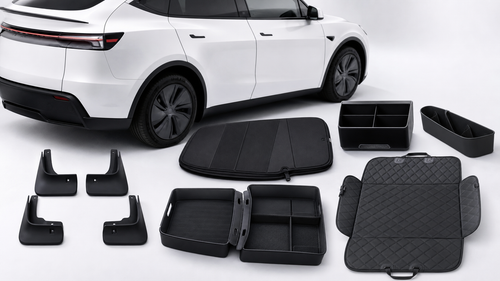
Gear up your Tesla with tested, custom-fit BASENOR accessories — shop Tesla accessories →
📋 Tracking Tesla software? See every firmware, FSD and app version in one place in our Tesla Software Update Tracker.
🤖 Tracking Tesla's humanoid robot? See every Optimus production milestone and appearance in our Tesla Optimus Tracker.
Related coverage
Sources & reporting notes
The links below identify the material source records used for this report.
- @SawyerMerritt on X (2026-11-21T16:51:00.000Z) — Direct source
Source links are preserved as published or accessed. See our editorial standards and corrections policy.
The BASENOR Editorial Desk covers Tesla, SpaceX, and related technology, curating reporting from primary sources — official accounts, regulatory filings, and software release data. Every article passes source-record and fact-checking review before publication. About the newsroom.
This report was curated by the BASENOR Editorial Desk from the sources listed above. Read our editorial standards or email editorial@basenor.com to report an error.