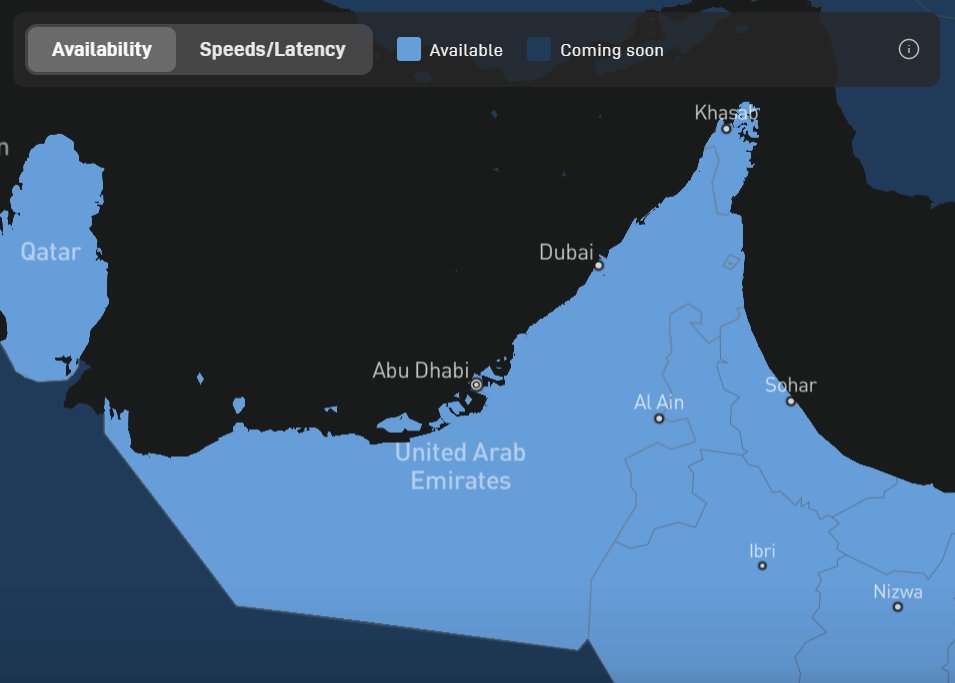
SpaceX's Starlink satellite internet service is now live in the United Arab Emirates, with both Elon Musk and the official Starlink account confirming the launch on September 3, 2026. The UAE becomes one of more than 150 countries and territories where Starlink operates — but this particular market carries some weight beyond the headline number.

Two Years in the Making
The path to this launch started in June 2024, when the UAE's Telecommunications and Digital Government Regulatory Authority (TDRA) granted Starlink Satellite Communications Services LLC a 10-year General Satellite Services License — valid through June 2034. That license covers residential, business, government, maritime, and aviation use. The TDRA Director-General, Majed Sultan Al Mesmar, described the license at the time as a move that would significantly enhance the UAE's telecommunications sector and support innovation.
Residential service officially went live on March 18, 2026, meaning the September 3 announcement marks a broader commercial push rather than a soft-launch moment. Starlink's social confirmation today signals the service has cleared whatever remaining operational hurdles existed before a full public rollout.
Pricing and Hardware
According to pricing data reported by Gulf News and Arabian Business, Starlink's UAE plans are structured as follows:
| Plan | Monthly (AED) | Approx. USD |
|---|---|---|
| Residential Lite | Dh230 | ~$63 |
| Standard Residential | Dh300 | ~$81 |
| Business (starting from) | Dh248 | ~$68 |
| Roaming / Portable (100GB) | Dh190 | ~$52 |
| Roaming / Portable (Unlimited) | Dh370 | ~$101 |
Hardware costs Dh1,465 (~$398) for the standard kit and Dh1,099 for the portable Mini Kit. Prospective subscribers in high-demand areas can join a waitlist with a Dh285.71 deposit, which is credited toward the kit price at purchase.
Performance specs sit at 50–200 Mbps download speeds with 20–40ms latency — competitive with fixed-line broadband in many parts of the country, and a significant step up from what satellite internet historically offered in the region.
The Capacity Caveat
Not everyone in the UAE can sign up today. According to reports from Gulf News, some urban areas — specifically Dubai and Abu Dhabi — are already at capacity, placing new subscribers on a waitlist. That's a familiar pattern from Starlink's early rollouts in other dense urban markets, and it reflects real satellite beam capacity constraints rather than regulatory issues. Residents across the other five Emirates should have more immediate access.
Aviation Already Ahead of Ground Service
One notable wrinkle: Starlink's presence in UAE airspace predates its ground service. Emirates airline and flydubai both introduced Starlink-powered in-flight Wi-Fi in 2025. Emirates has committed to rolling out free Starlink Wi-Fi across its entire fleet of 232 Boeing 777 and A380 aircraft, with the rollout beginning in November 2025 and targeting completion by mid-2027. That means UAE-based travelers were likely already experiencing Starlink performance before they could order a dish for their home.
Why This Market Matters for SpaceX
The UAE is a strategically dense market — high smartphone penetration, a large expat population with international connectivity needs, and a government that has positioned itself as a technology hub. The 10-year licensing term also signals regulatory stability that SpaceX can build on for enterprise and government contracts, not just consumer subscriptions. The TDRA license explicitly covers maritime and aviation sectors, which opens commercial lanes well beyond residential broadband.
For Starlink's global trajectory, the UAE launch is incremental rather than transformational on its own. But the combination of a long-term regulatory framework, an affluent consumer base, and existing aviation partnerships makes it a more commercially meaningful entry than a simple country-count addition. Whether the waitlist situation in Dubai and Abu Dhabi clears quickly — or lingers as it has in some other dense markets — will be the real test of how seriously SpaceX invested in UAE-specific capacity before flipping the switch. For more on Starlink and SpaceX's global expansion, see our SpaceX coverage.
Sources & reporting notes
The links below identify the material source records used for this report.
- @Starlink on X (2026-09-03T05:13:00.000Z) — Direct source
- @elonmusk on X (2026-09-03T05:26:42.000Z) — Direct source
Source links are preserved as published or accessed. See our editorial standards and corrections policy.
The BASENOR Editorial Desk covers Tesla, SpaceX, and related technology, curating reporting from primary sources — official accounts, regulatory filings, and software release data. Every article passes source-record and fact-checking review before publication. About the newsroom.
This report was curated by the BASENOR Editorial Desk from the sources listed above. Read our editorial standards or email editorial@basenor.com to report an error.