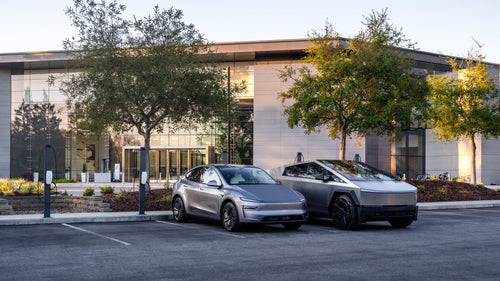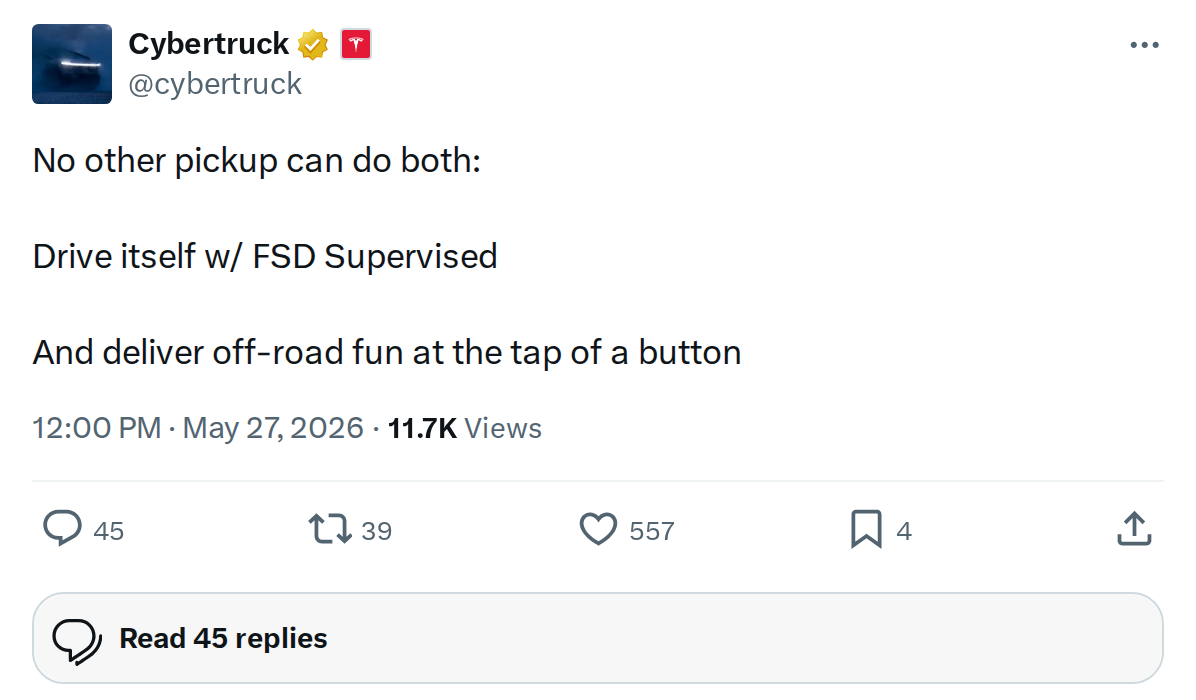
The official Cybertruck account made a pointed claim this week: no other pickup truck can pair autonomous driving assistance with serious off-road capability. It's a bold statement — and the hardware and software specs largely back it up. Here's a breakdown of the five capabilities that make the combination genuinely unique.

1. FSD Supervised Has Reached Full Feature Parity on Cybertruck
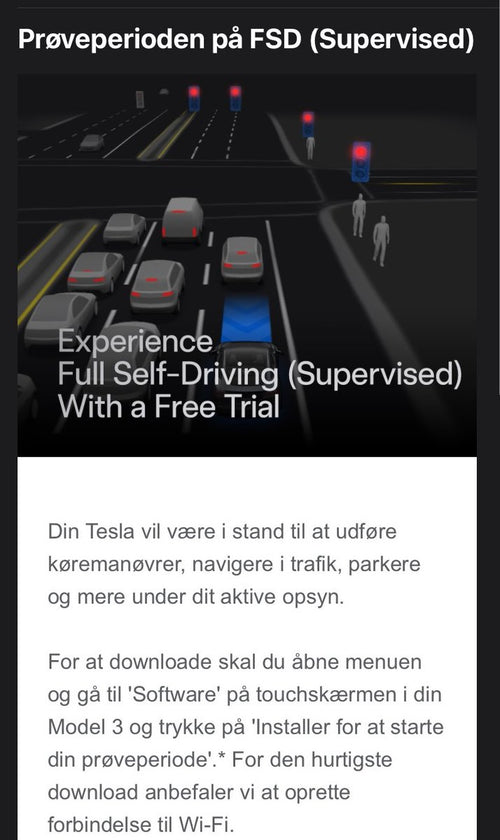
It wasn't always this way. When the Cybertruck launched in November 2023, FSD wasn't available at all. The rollout came in stages — v12.5.5 arrived for a subset of owners in September 2024, and by early 2025, Cybertrucks were receiving v13.2.4 with full-resolution AI4 video inputs. As of February 2026, FSD (Supervised) v14.2.2.5 brought the Cybertruck to complete feature parity with other Tesla models. That's a meaningful milestone: the truck now gets the same city-street navigation, lane changes, and intersection handling as a Model Y or Model 3.
2. Four Dedicated Off-Road Modes, Accessible in Two Taps
The "tap of a button" in the official tweet refers to the Off-Road app on the central display. It surfaces four distinct modes: Overland (maximizes traction at low speeds on mixed terrain), Baja (optimizes suspension and traction control for high-speed dirt and desert running), Wade Mode (raises suspension to Very High and pressurizes the high-voltage battery pack, enabling water crossings up to approximately 32 inches deep — limited to 30 minutes), and Trail Assist (holds a set speed between 1 and 25 mph for controlled ascents and descents). No other production pickup ships with this specific combination out of the box.
3. The Hardware Underneath Makes Both Systems Work
FSD Supervised relies on a vision-only neural network fed by multiple cameras around the vehicle. The off-road modes lean on a different set of hardware: four-wheel steering, steer-by-wire, adaptive damping, adjustable air springs, and front and rear locking differentials — mechanical on dual-motor variants, with a mechanical front and virtual rear on the Cyberbeast. Maximum ground clearance reaches 16.0 inches in High Air mode. These two systems share the same platform but operate largely independently, which is part of what makes the pairing technically interesting.
4. FSD Supervised Has Real Limits Off-Road — Worth Knowing
The claim is about capability, not seamless integration. FSD (Supervised) is designed for paved roadways and has been observed disengaging on washboard roads, in fog, or when trails become too narrow for the camera system to confidently track lane boundaries. Off-road, the driver is expected to be fully in control. The in-cabin camera monitors attentiveness and will disengage the system if the driver looks away. So the combination works in sequence — FSD on the highway to the trailhead, off-road modes once you leave the pavement — rather than as a unified system.
5. The Competitive Gap Is Real, For Now
No rival pickup currently ships with a comparable Level 2 driver-assistance system alongside a factory-integrated suite of off-road drive modes. Ford's BlueCruise and GM's Super Cruise cover highway hands-free driving but neither brand has paired that with the depth of off-road hardware the Cybertruck offers. That gap may narrow as competitors develop their own stacks, but as of mid-2026, the Cybertruck's combination remains without a direct equivalent in the segment.
The practical takeaway for owners: the two capabilities are best thought of as complementary rather than simultaneous. Use FSD Supervised to reduce fatigue on long highway stretches, then switch to the appropriate off-road mode when the pavement ends. Together, they cover a range of driving scenarios no single competitor currently matches.

Marcus covers Tesla's software releases, FSD rollouts, and OTA changes. Background in automotive engineering. Based in Austin.
Sources verified at publish time. Spotted an inaccuracy? Email editorial@basenor.com.